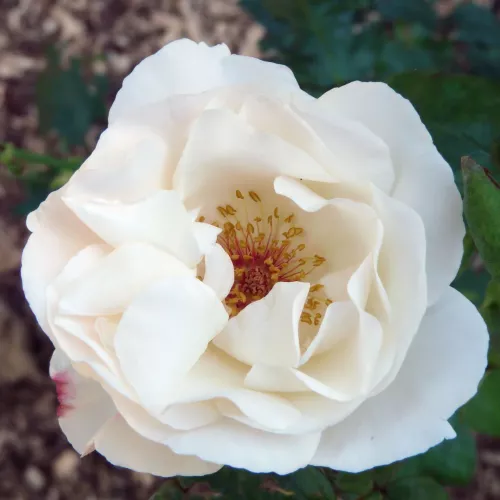
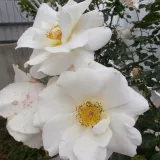
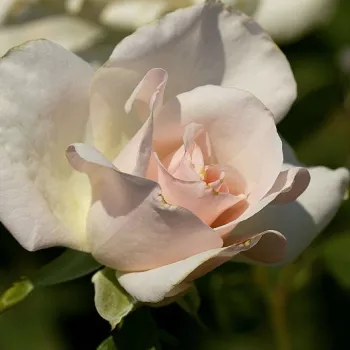
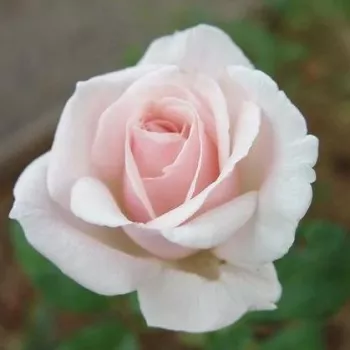
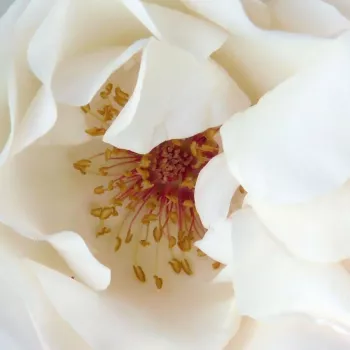
WHITE QUEEN ELIZABETH – white bedding floribunda rose - Banner
With its regal white blooms and upright, tidy habit, WHITE QUEEN ELIZABETH offers a reassuringly reliable choice for classic British front gardens and cottage-style borders. The medium-height, well-foliaged bush carries repeated flushes of large, high-centred flowers, providing abundant colour through the season with only modest deadheading and basic care. As an own-root plant, it settles steadily and builds long-term structure, giving you a stable, well-shaped shrub that copes well with typical British weather and breezier, rain-laden spells near the coast. The flowers have a gently elegant form, reminiscent of traditional cut roses, and a soft tea fragrance that is pleasantly noticeable without overwhelming smaller spaces. In normal garden conditions, it offers dependable garden performance with medium maintenance: straightforward feeding, watering in dry periods, and simple pruning. Over time the rose develops strong roots, then woody framework, and finally a mature display of full ornamental character, making it a reassuring long-term feature in family gardens.
Usage options
| Target area | Reasoning |
|---|
| Front garden focal shrub |
The upright, well-branched habit and dense dark-green foliage create a clear vertical accent that reads well from the pavement, while the white blooms stay clean-looking against brick or render. Simple annual pruning keeps the outline tidy for low-effort kerb appeal – ideal for the style-conscious beginner. |
| Small mixed border in family gardens |
Repeated flowering on strong stems provides reliable white highlights among perennials and grasses, without needing constant attention beyond occasional deadheading. Medium maintenance and moderate disease resistance suit busy households who want colour through summer without complex routines – perfect for time-poor garden owners. |
| Classic cottage-style bed |
The floribunda-style clusters and large, high-centred flowers blend naturally with cottage staples such as foxgloves and salvias, giving a soft, traditional look. Own-root growth ensures the shrub gradually knits into its surroundings, forming a long-lived framework that rewards simple, regular care – reassuring for cottage-garden enthusiasts. |
| Cut-flower corner or cutting bed |
Long, straight stems and high-centred buds make this rose particularly suitable for vases, offering repeat harvests of elegant white blooms through the season. Medium fragrance allows it to combine easily with other flowers indoors without overpowering arrangements – appealing to home florists and creative decorators. |
| Formal bedding layout or rose parterre |
Uniform height, upright structure and consistent white colouring allow precise geometric planting for beds and borders. The clear planting distances support evenly spaced plants that mature into a balanced, structured display, with maintenance focused on simple feeding and shaping – suited to gardeners planning ordered, formal schemes. |
| Informal group planting of 3–5 shrubs |
Planting in small groups softens boundaries and corners, with overlapping canopies creating a generous visual block of white flowers above glossy foliage. Own-root plants establish steadily into a coherent, durable stand that responds well to straightforward, once-a-year pruning – attractive to those wanting impact without fuss. |
| Urban and courtyard gardens |
The medium height and upright habit fit well into smaller plots without dominating, while the white blooms brighten enclosed spaces and paved areas. Average heat and drought tolerance works in sheltered urban microclimates, provided occasional watering is given in dry spells – practical for city gardeners with limited time. |
| Large container or terrace planter (40–50 litres+) |
In a generously sized pot with good drainage, the structured, upright growth and repeat-flowering habit give a long season of interest near doors and seating areas. The shrub remains manageable with light annual pruning and routine feeding, keeping its shape and bloom quality – a good option for balcony and patio gardeners. |
Styling ideas
- Regal entrance – flank a front path with matching pairs, underplant with low lavender or catmint for a soft blue contrast – ideal for homeowners seeking classic kerb appeal.
- Cottage ribbon – weave through a border with foxgloves, hardy geraniums and lady’s mantle for a loose, traditional mix – suited to lovers of romantic cottage gardens.
- White-and-green – combine with box balls, ornamental grasses and white alliums for a restrained, architectural palette – appealing to fans of calm, minimalist planting.
- Cutting corner – group three plants with annuals like cosmos and sweet peas to supply the house with vase material – perfect for creative gardeners who enjoy arranging flowers.
- Sunny terrace – place a single rose in a 50-litre container with trailing thyme and small heucheras to soften the rim – great for balcony and patio gardeners wanting easy summer colour.
Technical cultivar profile
| Parameter | Data |
|---|
| Name and registration |
White Queen Elizabeth – floribunda / Hybrid Tea sport of ‘Queen Elizabeth’, registered and introduced in 1965, marketed as a white bedding floribunda and verified for cultivar authenticity. |
| Origin and breeding |
Sport of ‘Queen Elizabeth’ bred by Banner in the United Kingdom, 1965; breeder and early distribution data are incomplete, but the type reflects mid-20th-century English floribunda breeding. |
| Growth and structural characteristics |
Strong, upright shrub 130–170 cm high and 100–140 cm wide with dense, glossy dark-green foliage and moderate thorns, forming a well-filled, vertical presence in beds and borders. |
| Flower morphology |
Large, double, high-centred blooms with 26–39 petals, carried mainly in clusters on floribunda-style stems; remontant, with a notably abundant second flush in suitable conditions. |
| Colour data and phenology |
Snow-white flowers with pearly inner sheen; buds may show a light pink blush, opening to white with occasional pale pink tones, then fading gently to creamy white while remaining visually white. |
| Fragrance and aroma |
Medium-strength tea fragrance, clearly noticeable at close range but not overpowering, contributing to a refined, traditional rose character suitable for seating areas and cutting gardens. |
| Hip characteristics |
Minimal hip formation expected; where present, hips are small, egg-shaped, 10–14 mm in diameter, maturing to orange-red but adding only modest ornamental effect in most plantings. |
| Resistance and winter hardiness |
Hardy to approximately -26 to -23 °C (RHS H7, USDA 5b, Swedish zone 4); moderate resistance to black spot, powdery mildew and rust; average heat and drought tolerance with watering in dry spells. |
| Horticultural recommendations |
Best in full sun with fertile, well-drained soil; deadhead to encourage repeat bloom and prune in late winter; spacing 110–180 cm depending on use, with 0.7–0.8 plants/m² for mass planting. |
WHITE QUEEN ELIZABETH offers elegant, repeatedly flowering white blooms on a long-lived, own-root shrub that forms a stable garden feature with straightforward care, making it a thoughtful choice for lasting beauty in family gardens.