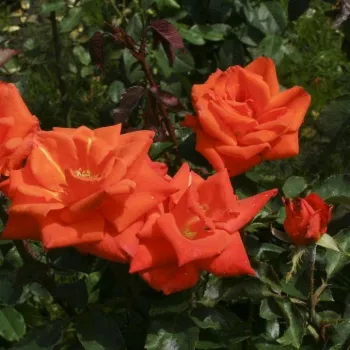
Prominent® – orange-red grandiflora bedding rose - Kordes
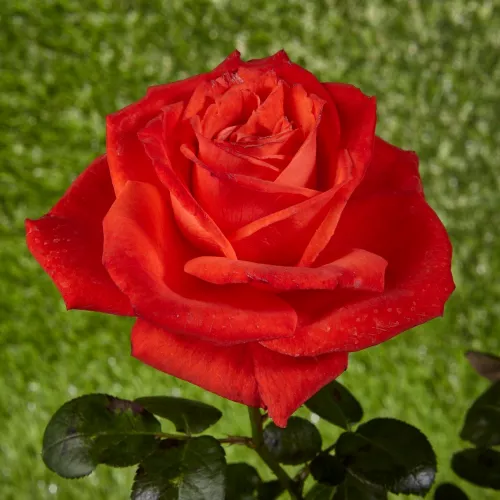
Prominent brings reliable, colour-rich flowering to small family gardens, giving you an upright, bushy rose that fits neatly into beds and borders without complicated pruning. The bright orange-red blooms repeat generously through summer, keeping front gardens and paths inviting with minimal effort. Own-root growth supports long-term stability, so the shrub matures steadily and responds well to typical British care routines in sun and partial exposure. Over time the roots, then shoots, then full display develop into a lasting feature that copes well with typical UK rainfall and breezy conditions, provided soil drainage is sensible. Medium maintenance needs, occasional deadheading and basic feeding are usually enough to sustain its dense, dark green foliage and clean outline. This makes it a reassuring choice if you want classic bedding structure and season-long impact without specialist know-how, ideal as a compact, hedge or as a strong focal clump in a mixed cottage-style scheme.
Usage options
| Target area | Reasoning |
|---|
| Front garden feature bed |
The upright, compact habit and generous repeat flowering make this rose ideal for a small front bed where you want eye-catching colour but limited height. The dense dark foliage gives a tidy, well-kept look with only moderate deadheading and light seasonal pruning, helping maintain kerb appeal without weekly attention for the time-pressed beginner. |
| Mixed cottage border |
Its bright orange-red flowers stand out among perennials and traditional cottage plants, while the bushy shape slots neatly between lower mounds and taller back-of-border shrubs. Medium disease resistance and own-root resilience support a long-lived framework that copes well alongside classic companions such as honeysuckle and campanula, suiting the relaxed yet ordered gardener homeowner. |
| Small group planting (3–5 plants) |
Planted in a triangle or drift, groups of this variety create a solid block of colour that reads clearly from the street or patio. Recommended spacings make it straightforward to plan for even coverage, and the consistent height means the planting remains level and cohesive, offering satisfying results for those who prefer simple, repeatable layouts gardener. |
| Low flowering hedge |
Regular spacing around 40 cm allows it to form a low, semi-formal edging that frames paths or separates lawn from borders. The dense foliage and upright canes knit together into a continuous line, while repeat blooms bring seasonal interest; routine trimming is uncomplicated, supporting those who like structured outlines without complex topiary owner. |
| Urban front garden with clay soil |
In many town gardens with heavier soils, this rose performs reliably when given basic attention to drainage, for example raised beds or improved planting holes. Once established, its own-root system supports steady regrowth and a durable shrub, while its medium maintenance needs fit busy lifestyles in small, functional spaces for the typical city resident. |
| Rose-and-clematis pairing |
The upright framework and medium-sized flowers provide an excellent support backdrop for light clematis varieties, allowing contrasting colours to weave between the orange-red blooms. Its recurring flushes give structure even when climbers are between peaks, helping you build a layered, romantic effect with relatively few plants and straightforward seasonal care for the aspirational stylist. |
| Park-style corner in a family garden |
Using several plants at the recommended density, you can recreate a small park-style bed in a corner or side area, offering strong, repeated colour with an orderly outline. The rose’s moderate disease resistance and winter hardiness allow it to settle into a long-term, low-complexity display that children and adults enjoy through the seasons for the practical family gardener. |
| Sunny terrace in large containers |
When grown in generous containers of at least 40–50 litres with good drainage, this rose provides an upright, floriferous accent for patios and terraces. Adequate watering and feeding support its repeat flowering, and its compact spread suits paved spaces, giving a durable, season-long feature without elaborate planting schemes for the busy patio owner. |
Styling ideas
- Cottage Glow – Combine with trailing bellflower and soft pink perennials to let the orange-red blooms punctuate a relaxed, cottage-style border – ideal for romantically inclined beginners.
- Frontage Frame – Use as a low hedge along a path or drive, underplanting with low evergreen groundcovers to keep the line tidy year-round – suited to homeowners focused on kerb appeal.
- Terrace Accent – Plant a single shrub in a 50-litre terracotta pot with gravel mulch, letting its upright form and repeat flowering anchor a small seating area – perfect for busy urban balcony gardeners.
- Park-Edge Drift – Mass three to five plants in a bed with ornamental grasses and simple shrubs to echo municipal park plantings in a domestic setting – for those who like structured yet low-fuss designs.
- Colour Duet – Thread a light-flowering clematis through the bush, choosing contrasting purples or creams to create a layered vertical accent – attractive for style-conscious hobby gardeners.
Technical cultivar profile
| Name and registration |
Grandiflora bed rose registered as KORp, marketed as Prominent® bedding rose. Classified as a flowerbed grandiflora with exhibition suitability; ARS exhibition name Prominent® for show and cutting use. |
| Origin and breeding |
Bred by Reimer Kordes at W. Kordes’ Söhne, Germany, in 1971 from ‘Colour Wonder’ × ‘Zorina’. Introduced after 1973 through several distributors in the UK, France and Australia. |
| Awards and recognition |
Highly decorated cultivar: RNRS Certificate of Merit 1970, ADR German certification 1971, Portland Gold Medal 1975 and All-America Rose Selection winner 1977, confirming strong garden performance. |
| Growth and structural characteristics |
Upright, bushy shrub typically 70–95 cm tall and 55–75 cm wide with dense, matt, dark green foliage and moderate prickles. Self-cleaning is only partial, so spent blooms benefit from occasional removal. |
| Flower morphology |
Large, double, cupped flowers with 26–39 petals borne mainly singly on stems. A reliable repeat bloomer, producing a generous second flush that maintains decorative value through the main season. |
| Colour data and phenology |
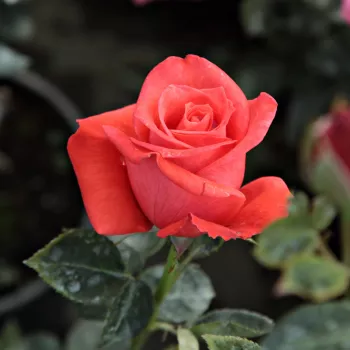
Bright orange-red blooms (RHS 46A–46B) with subtle reddish depth. Buds open fiery orange with yellow-orange reflexes, then soften slightly in strong sun while retaining a vivid, even surface in full bloom. |
| Fragrance and aroma |
Mild, pleasantly elegant fragrance of classic rose character, noticeable at close range but not overpowering. Primarily grown for its colour display and form rather than for strong scent in the garden. |
| Hip characteristics |
Rose-hip set is usually sparse due to the double blooms, though occasional small ellipsoidal orange-red hips 10–14 mm can appear, adding modest late-season interest in some years. |
| Resistance and winter hardiness |
Rated H7 and hardy to approximately −26 to −23 °C (USDA 5b), coping well with typical UK winters. Disease resistance is medium for black spot, powdery mildew and rust, benefiting from basic preventative care. |
| Horticultural recommendations |
Performs best in full sun with fertile, well-drained soil; moderate drought tolerance only. Space 40–70 cm depending on use, with planting densities around 4.7–5.5 plants/m² for mass effect or hedging. |
Prominent® offers vivid orange-red repeat flowering, a compact upright shape and durable own-root growth for long-term beds and borders, making it a thoughtful choice if you prefer dependable roses with manageable care.