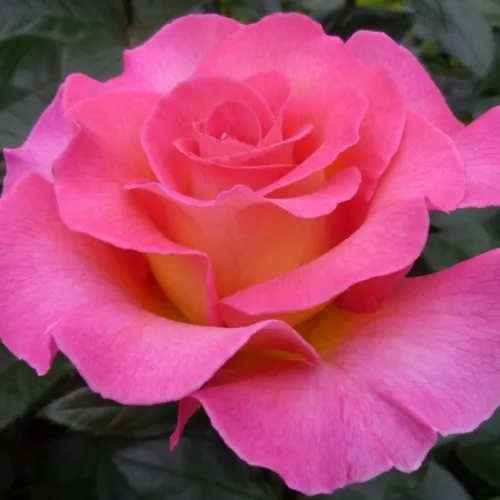
Vivid fuchsia-coloured petals with a golden-yellow base. - hybrid tea rose - strong, long-lasting scented rose - sweet, spicy
– Strong, long-lasting Grands Parfums fragrance
– Elegant high‑centred blooms for cutting
– Premium disease resistance, ADR certified
– Reliable repeat flowering through the season
– Compact, upright habit for beds and hedges
– Különleges jellemző: Többszörös díjnyertes, Gold Standard és „Plus belle rose de France” elismeréssel.
Unfortunately, we are currently unable to ship to the United Kingdom; we only deliver to countries within the European Union. For more information, please contact us!
3(3455)
Pink Paradise – hybrid tea rose
With its intensely fragrant blooms and classic hybrid tea elegance, Pink Paradise brings a touch of Parisian cabaret glamour to everyday gardens while remaining reassuringly easy to live with. Bushes are naturally upright and compact, ideal for smaller British front gardens where you want order rather than sprawling growth, yet the plant still produces a steady flush of large, double flowers for reliable display. Strong health and ADR-level resistance mean fewer sprays and simpler care, and the own-root form builds a deep, resilient framework that supports a long garden life with minimal replacement. In heavier or wetter plots it copes well when given decent drainage and a spot that stands up to coastal wind and rain, fitting comfortably into normal family-garden routines. Over the first seasons you see a natural development arc – roots bedding in during year one, stronger top growth in year two, and full, luxuriant flowering character by year three. Excellent vase life and long stems make it a superb cutting rose for the house, while the premium breeding and award-winning pedigree provide quiet confidence that it will perform dependably season after season.
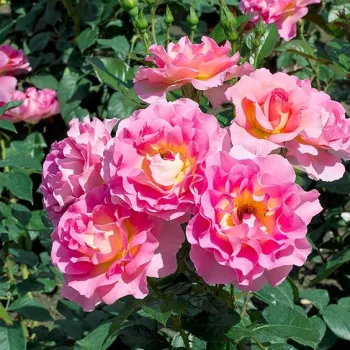
Pink Paradise in the late flowering stage, with petals fading from fuchsia to pastel pink.
High-centred, double blooms of Pink Paradise.
Usage options
Target area
Reasoning
Front garden feature rose
Planted near the path or front door, Pink Paradise forms a neat, upright bush that stays within typical front-garden scale while still producing showy, exhibition-style blooms. Its tidy outline suits simple layouts that are quick to maintain for beginners.
Cutting patch in a family garden
The long, straight stems and high-centred buds are ideal for cutting, giving you florist-style roses from a modest bed. Blooms open slowly and hold well in the vase, so a few plants provide regular, scented bunches for the home for homeowners.
Small mixed border with perennials
The compact spread allows easy pairing with low perennials such as dwarf heuchera or creeping thyme without overcrowding. Its repeat flowering supplies vertical accent and colour between herbaceous waves, with minimal pruning complexity for hobby-gardeners.
Sunny rose bed for repeat colour
Where you want steady colour rather than complex planting schemes, its reliable remontant habit provides regular flushes through the season. Own-root plants bulk up gradually, maintaining even spacing and long-term structure that suits low-intervention care for busy-urban-gardeners.
Statement specimen near a seating area
The strong, sweet–spicy perfume is best appreciated up close, so a single bush by a bench or terrace works beautifully. Upright growth keeps the plant off pathways, while glossy dark foliage delivers a composed, formal look valued by aesthetes.
Small group planting (3–5 plants)
Planting a loose group at the recommended spacing creates a coherent block of colour without becoming overpowering in a modest plot. Own-root growth slowly knits the group together into a balanced, long-lived display that reassures cautious beginners.
Rose bed in heavier or wetter soils
In typical British clay or damper regions, planting into improved soil or a low raised bed helps roots establish while the robust, award-recognised constitution copes with exposed, breezy sites and unsettled weather that can discourage less committed gardeners.
Large container on patio or balcony
In a 40–50 litre or larger container, its upright habit and dense foliage create a vertical accent without excessive spread, and the strong fragrance enriches compact outdoor sitting spaces. Regular watering and feeding are straightforward tasks for time-pressed city-dwellers.
Styling ideas
COTTAGE BORDER FOCUS – Combine Pink Paradise with catmint, dwarf lady’s mantle and low thyme edging for a classic, frothy cottage look that still feels tidy – ideal for lovers of traditional, romantic front gardens.
FORMAL PATHWAY PAIR – Plant matched bushes on either side of a path or gate, underplanted with clipped lavender, to create a scented, structured welcome – suited to homeowners who prefer order and symmetry.
SCENTED CUTTING BED – Arrange a short row of Pink Paradise with hardy annuals like cosmos behind for extra stems, keeping the layout simple for regular picking – perfect for busy gardeners who enjoy flowers indoors.
LOW-MAINTENANCE MIX – Set among coral bells and groundcover sedums, the rose provides vertical colour while the perennials keep weeds down – a good option for beginners wanting impact without complex upkeep.
CONTEMPORARY PATIO FEATURE – Grow one plant in a large charcoal container with fine gravel mulch for a clean, modern look that draws attention to the blooms – appealing to style-conscious urban gardeners with limited space.
Technical cultivar profile
Parameter
Data
Name and registration
Hybrid tea rose, registered as DELfluros, marketed as Pink Paradise in the Grands Parfums collection; also exhibited under the name Julie Andrews for show and cut-flower purposes.
Origin and breeding
Bred by Georges Delbard in France (2004) and introduced in 2011 through Delbard/Georges Delbard SA, with subsequent distribution in Europe, the USA and South Africa.
Awards and recognition
Highly decorated: gold medals at Baden-Baden and Geneva (2010), silver at Barcelona, Plus belle rose de France and ADR certification (2011), plus United Kingdom Gold Standard award (2012).
Growth and structural characteristics
Medium-height, upright bush reaching around 80–100 cm tall and 50–70 cm wide, with dense, glossy dark green foliage and moderate prickles; spent blooms may occasionally need deadheading by hand.
Flower morphology
Large, double flowers with 26–39 petals, high-centred hybrid-tea form and pointed buds, mostly borne singly on stems; remontant habit provides generous first and second flushes in suitable conditions.
Colour data and phenology
Vivid fuchsia-pink petals with a golden-yellow base, shifting through mid-pink to pastel tones as blooms age; colour retention is moderate, giving gentle tonal changes rather than a single fixed shade.
Fragrance and aroma
Strong, long-lasting fragrance in the classic Grands Parfums style, with sweet and spicy notes; ideal for planting where scent can be enjoyed at close quarters or for use as scented cut flowers indoors.
Hip characteristics
Very double flowers set hips only sporadically; occasional small, spherical, bright red hips of about 10–14 mm may form, adding discreet seasonal interest without dominating the plant’s appearance.
Resistance and winter hardiness
Rated H7 with approximate hardiness to around −21 °C and USDA zone 6b; strong resistance to powdery mildew, black spot and rust, performing reliably in typical rose-growing regions with normal care.
Horticultural recommendations
Preferably planted in a sunny, well-drained position at about 60 cm spacing for beds; own-root plants suit long-term garden use, with regular watering, feeding and light pruning for best display.
Pink Paradise combines strong fragrance, compact upright growth and award-backed health in an own-root form that matures into a long-lived feature, making it a thoughtful choice if you want reliable beauty with modest effort.
Competition and Show Awards:
Baden-Baden – Gold medal (2010); Geneva – Gold medal (2010); Barcelona – Silver medal (2010); Lyon – Plus belle rose de France / The most beautiful rose of the century (2011); Germany – ADR certification (2011); United Kingdom – Gold Standard award (2012)
Closed Bud:
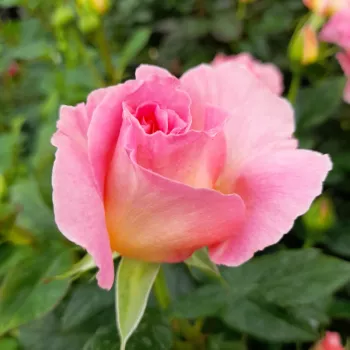
Deep pink with a yellowish tint at the base.
Newly Opened Flower:
Bright cyclamen-pink edge, warm golden-yellow glow inside.
Full Bloom:
The surface fades to a medium pink, while the petal base remains golden yellow.
Before Fading:
Pastel pink, with the yellow tone blending into a creamy colour.
Colour Fading Description:
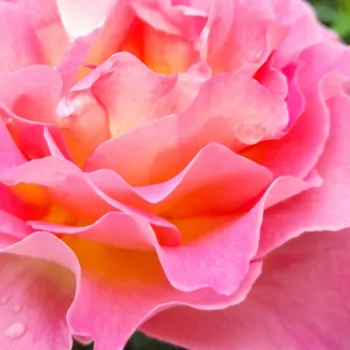
As it opens, the vivid fuchsia colour fades to mid‑pink and then to a pastel pink, while the golden‑yellow base merges into cream.
Pollinator Attraction:
Its very double, deeply quartered blooms are therefore likely to attract pollinators less, because flower form (simple/semi‑double/double) and restricted access to the stamens reduce the availability of nectar and pollen.
Hip Comment:
Fruit set is likely to be sparse due to the very double flowers; occasionally spherical, bright red (RHS 42A) hips 10–14 mm in diameter may form.
Our product is a rose grown with pharmaROSA®’s unique cultivation technology!
2-litre, own-root, potted rose.
With a shoot system appropriate to the season.
With a root system that thoroughly permeates the growing medium.
Quality compliant with the requirements of the E.N.A. (European Nurserystock Association).
Supplied in unique packaging that prevents damage.
Can be planted during frost-free periods.
True-to-variety rose bush with a unique identifier.
The pharmaROSA® own-root potted rose is a well-rooted plant that supports reliable establishment when planted and cared for properly, so it can be planted whenever the soil is not frozen.
Crop overview: several varieties and growth stages in a short crop section.Shoot system: intensive growth of fresh basal shoots on a young plant.Root system: demonstration of a vigorous root system permeating the growing medium, by removing the pot.Balance: mature plant with root system and shoots in harmony with each other.
Information about the videos
The video series is not a “seasonal showcase”; it illustrates the essence of pharmaROSA® own-root cultivation in a tangible way: how the plant is built up, what the root system is like and how the shoot system regenerates. The recordings were therefore made at different times and with plants at various stages of development, so mixed foliage levels and differing stages of growth may appear in the videos. They are not a ‘sample’ of the batch dispatched, but a visual explanation of how the technology works. The current condition of the rose available to order — typical for the given period and similar to what you can expect to receive in the parcel — is shown in the upper part of the product page.
Pages for private customers Garden roses for the family garden, with minimal care → ORIGINAL® Premium garden roses – instant impact, a truly showpiece garden → EXTRA® Pages for professionals and private customers Roses for public spaces – large areas, sustainable maintenance → NATURAL® Roses for projects – hedge and row planting, fast implementation → RAPID® For professional partners only Production – propagation material for garden roses, wholesale → NEONATAL®
Company details
PharmaRosa Ltd. Company registration number: 01-09-717479 VAT number: 13075314-2-43 Plant health registration no.: HU130721 Bank account (IBAN): HU85117631891388688400000000 BIC (SWIFT): OTPVHUHB Bank name: OTP Bank Nyrt.