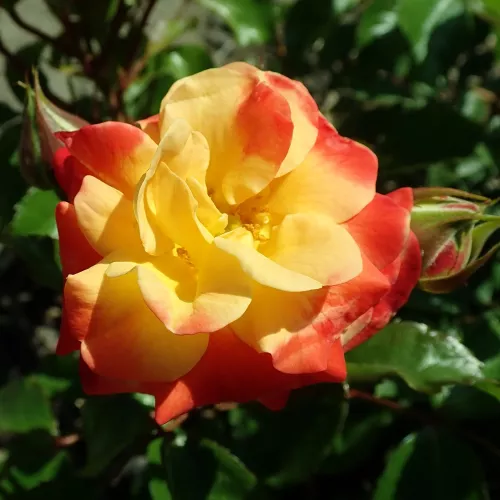
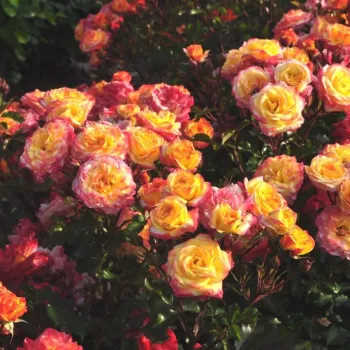
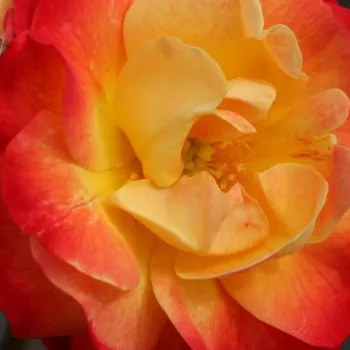
Petals with a golden-yellow base are covered by vivid scarlet-red edges and shading. - floribunda bedding rose - very weak, barely perceptible scented rose - fruity
– Spectacular yellow‑red blooms with flame‑like effect
– Compact upright habit for beds and borders
– Glossy dark green foliage gives elegant contrast
– Reliable remontant flowering with strong second flush
– Good hardiness to about –25 °C (RHS H7)
– Special feature: Awarded Le Roeulx Audience Prize and other show honours.
Elegant spaces – Long lifespan
pharmaROSA® ORIGINAL 2-litre own-root potted rose
18,70 £
Unfortunately, we are currently unable to ship to the United Kingdom; we only deliver to countries within the European Union. For more information, please contact us!
3(4329)
FIREBIRD ® – yellow-red bedding floribunda rose - Kordes
With its spectacular, flame-like display of colour, FIREBIRD captures classic front-garden charm while remaining reassuringly simple to grow in everyday family settings. This compact floribunda forms a tidy, upright bush that sits neatly at the front of borders or beside paths, gradually settling into heavy or light soils as long as drainage is sensibly managed. Clusters of medium-sized, double blooms open golden-yellow with vivid red edges, then shift through glowing orange tones to deep crimson, creating a continuous impression of fire over the season. Bred by Kordes for garden performance, it combines reliable, repeat flowering with hardy, dark green, glossy foliage that stands up well in typical British humidity and rain-swept coastal breezes. As an own-root rose, FIREBIRD develops into a stable, well-balanced shrub over the years, capable of gentle regeneration and long-lived beauty with modest care, moving from root establishment to fuller flowering and then to its best ornamental display over its first three seasons.
Firebird® showing its double blooms with 26–39 petals and a softly visible centre.
Usage options
Target area
Reasoning
Front garden focal clump (3–5 plants)
Planting small groups of FIREBIRD at typical front-garden depths creates a compact, upright block of colour that looks carefully planned without demanding complex design skills. The steady, repeat flowering and dense foliage help the area look full and finished from the street side, even when the rest of the garden is still developing. Its own-root habit encourages a long-lived, balanced clump that can be lightly refreshed rather than replaced, suiting beginners.
Low maintenance mixed border in family gardens
In a mixed border, FIREBIRD’s medium height and tidy habit slot easily between perennials and small shrubs, giving strong colour without overshadowing neighbouring plants. The rose’s disease resistance to powdery mildew and black spot, together with moderate care needs, helps you keep borders looking clean without constant spraying. Over time, the bush fills out from its own roots, providing enduring structure that only needs basic seasonal pruning, ideal for busy.
Compact cottage-style planting by paths and drives
FIREBIRD’s changing yellow-red flowers give a lively, traditional cottage feel along paths and drives, yet the shrubs remain neat enough for tighter urban frontages. Clusters of medium blooms repeat well, so there are usually flowers or buds on show when you come and go. The plant’s moderate maintenance needs and own-root resilience mean you can keep the cottage effect going for years with simple deadheading and an annual trim, making it attractive to homeowners.
Small beds and geometric bedding schemes
The floribunda character of FIREBIRD suits patterned or geometric bedding, where repeat clusters of double flowers quickly build the intended effect. Its upright, uniform growth makes layout and spacing straightforward, even for novice gardeners following simple planting diagrams. Once established, the own-root structure supports long-term symmetry without regular replanting, a practical choice for those wanting orderly borders with minimal adjustments, especially planners.
Accent planting near patios and seating areas
Positioned near a patio or seating area, the colour shift from yellow and red to deep crimson becomes a constant source of interest at close quarters. Although the fragrance is very light, the vivid, changing blooms draw the eye without overwhelming small spaces. The rose’s compact, upright habit stays contained around furniture and paving, needing only moderate pruning to keep shape, an advantage for terrace and courtyard owners.
Containers and large patio pots (40–50 litres or more)
In large, well-drained containers of at least 40–50 litres, FIREBIRD offers season-long colour where borders are limited, such as paved front gardens or rented properties. The tidy growth and medium height are easy to manage in pots, while its own-root nature allows the plant to adapt gradually to pot culture if watering and feeding are reasonably regular. This gives reliable return from a single planting, an appealing prospect for space-conscious gardeners.
Family-friendly front gardens in exposed or coastal spots
FIREBIRD’s robust foliage and solid branching help it stand up in more exposed gardens, coping well with typical British wet and windy spells in coastal or open-suburban settings. Good resistance to key diseases reduces the need for repeated treatments, which suits family spaces where children and pets share the garden. Over time the own-root base anchors the plant firmly, lowering the risk of windrock in soft or improved soils, reassuring cautious buyers.
Long-term, easy-care rose feature for beginners
For new rose growers, FIREBIRD offers a straightforward way into rose care: plant, water, feed a little, and it responds with regular clusters of colourful blooms. The combination of winter hardiness, disease resistance and own-root durability supports a long lifespan with only moderate pruning decisions to make each year. In many British gardens it adapts to existing soil conditions, provided basic drainage is considered, allowing confidence to grow alongside the plant for tentative starters.
Styling ideas
COTTAGE CLUSTER – Group 3–5 FIREBIRD plants with catmint and hardy geraniums for a relaxed cottage feel at the front of borders – ideal for lovers of informal front gardens.
STRUCTURED STRIPE – Line a drive or path with evenly spaced FIREBIRD, underplanted with low evergreen groundcovers for a tidy, repeatable pattern – suited to homeowners who like clear structure.
PATIO SHOWCASE – Place a single FIREBIRD in a 50-litre terracotta pot, surrounded by dwarf fountain grass for soft movement and strong colour contrast – perfect for balcony and courtyard gardeners.
FAMILY BED – Combine FIREBIRD with compact shrubs and saxifrage in a small rectangular bed to create a durable, low-effort family feature – good for busy parents wanting quick impact.
COASTAL MIX – Blend FIREBIRD with tough ornamental grasses and dwarf honeysuckle in exposed gardens to enjoy colour against resilient textures – appealing to gardeners in breezy, seaside locations.
Technical cultivar profile
Parameter
Data
Name and registration
Floribunda bedding rose, registered as KORtragoso; marketed as FIREBIRD, Firebird ® and Fantasia® within the Fantasia® collection; recognised as a bush rose and exhibition floribunda.
Origin and breeding
Bred in Germany in 2005 by Tim-Hermann Kordes from unnamed Rosa hybrida lines; introduced in 2015 by W. Kordes’ Söhne and Star Roses & Plants in Europe and North America.
Awards and recognition
Holder of the Audience Prize at Le Roeulx, Belgium (2014), and further recognised with awards at international rose competitions, confirming both garden appeal and show quality.
Growth and structural characteristics
Compact, upright bush reaching about 60–80 cm in height and 45–65 cm spread, with dense, dark green, glossy foliage and moderate prickles, forming a tidy, structural garden shrub.
Flower morphology
Medium-sized, cupped, double flowers with 26–39 petals are carried in clusters; remontant habit ensures generous repeat flushes after the main flowering, creating extended seasonal display.
Colour data and phenology
Yellow-red bicolour blooms with golden-yellow bases and vivid scarlet edges; colours shift through orange to almost crimson red rather than fading, especially pronounced in strong sunlight.
Fragrance and aroma
Fruity fragrance of very weak intensity; scent is barely perceptible in normal garden conditions, making this variety primarily a visual ornamental rather than a fragrance feature.
Hip characteristics
Due to double flowers, hips are scarce; when present, they are small spherical orange-red hips, around 6–10 mm in diameter, adding only occasional late-season interest to the shrub.
Resistance and winter hardiness
Hardy to approximately -26 to -23 °C (RHS H7, Swedish zone 4, USDA 5b); resistant to powdery mildew and black spot, with medium rust resistance under typical garden conditions.
Horticultural recommendations
Suited to beds, borders and pots; medium maintenance with occasional plant protection; plant 35–60 cm apart depending on use, at around 6.3–7.2 plants per m² for massed displays.
FIREBIRD ® offers compact, colourful clusters, good disease resistance and long-lived own-root reliability for easy, enduring planting in family gardens; consider it if you would like dependable cottage-style colour without complex care.
Meaning of Cultivar Name:
The name means "firebird", refers to the flowers' spectacular, flame‑like display of colour, and was chosen in honour of the German "Appen musiziert" charity event.
Flower Colour Description:
Petals with a golden-yellow base are covered by vivid scarlet-red edges and shading.
Closed Bud:
The outer surface is a rich scarlet red with a delicate yellow flush at the tip.
Newly Opened Flower:
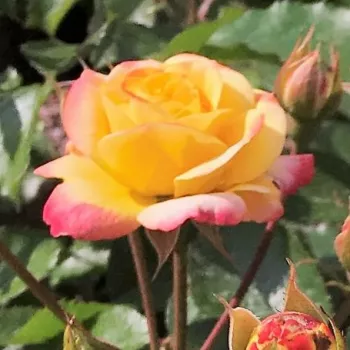
The petal base is an intense mid-yellow, and the edges are a vivid blood-red.
Full Bloom:
The yellow centre is only faintly visible through the outer petals, which change to an almost entirely red colour.
Before Fading:
The red tone darkens to crimson while the yellow base colour mutes to a deep orange.
Colour Fading Description:
On opening the yellow base deepens to a rich orange, the outer petals change to almost pure red and, before the blooms fade, darken to a crimson red; a colour shift rather than fading is typical.
Pollinator Attraction:
Due to its double flowers with 26–39 petals and the reduced accessibility of the stamens, it attracts pollinators only to a limited extent.
Pollinator-Friendly Rating:
Double flowers partially conceal the stamens, primarily an ornamental variety
Hip Comment:
Rosehip production is expected to be low due to the double flowers; occasionally spherical, 6–10 mm in diameter orange‑red (RHS 34A) rosehips may appear.
Our product is a rose grown with pharmaROSA®’s unique cultivation technology!
2-litre, own-root, potted rose.
With a shoot system appropriate to the season.
With a root system that thoroughly permeates the growing medium.
Quality compliant with the requirements of the E.N.A. (European Nurserystock Association).
Supplied in unique packaging that prevents damage.
Can be planted during frost-free periods.
True-to-variety rose bush with a unique identifier.
The pharmaROSA® own-root potted rose is a well-rooted plant that supports reliable establishment when planted and cared for properly, so it can be planted whenever the soil is not frozen.
Crop overview: several varieties and growth stages in a short crop section.Shoot system: intensive growth of fresh basal shoots on a young plant.Root system: demonstration of a vigorous root system permeating the growing medium, by removing the pot.Balance: mature plant with root system and shoots in harmony with each other.
Information about the videos
The video series is not a “seasonal showcase”; it illustrates the essence of pharmaROSA® own-root cultivation in a tangible way: how the plant is built up, what the root system is like and how the shoot system regenerates. The recordings were therefore made at different times and with plants at various stages of development, so mixed foliage levels and differing stages of growth may appear in the videos. They are not a ‘sample’ of the batch dispatched, but a visual explanation of how the technology works. The current condition of the rose available to order — typical for the given period and similar to what you can expect to receive in the parcel — is shown in the upper part of the product page.
Pages for private customers Garden roses for the family garden, with minimal care → ORIGINAL® Premium garden roses – instant impact, a truly showpiece garden → EXTRA® Pages for professionals and private customers Roses for public spaces – large areas, sustainable maintenance → NATURAL® Roses for projects – hedge and row planting, fast implementation → RAPID® For professional partners only Production – propagation material for garden roses, wholesale → NEONATAL®
Company details
PharmaRosa Ltd. Company registration number: 01-09-717479 VAT number: 13075314-2-43 Plant health registration no.: HU130721 Bank account (IBAN): HU85117631891388688400000000 BIC (SWIFT): OTPVHUHB Bank name: OTP Bank Nyrt.