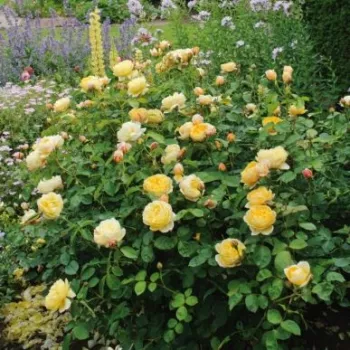
CHARLOTTE – yellow English rose - Austin
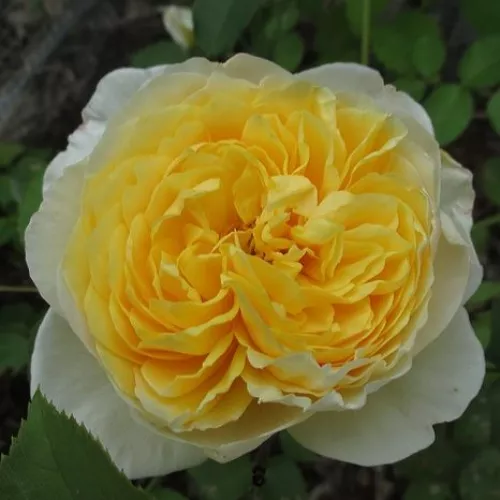
Classic cottage charm meets reliable repeat-flowering in ‘Charlotte’, a softly glowing yellow English shrub rose that settles beautifully into typical British front gardens and family plots. Its bushy, upright habit forms a dense, rounded shrub that fits naturally into small beds, borders and around-the-house plantings, creating a tidy, long-lived structure with minimal shaping. The fully double rosette blooms bring a gently romantic colour accent in creamy lemon yellow, repeatedly through the season, while a medium-strength tea fragrance lends refined character to paths and seating areas. As an own-root plant it establishes steadily and regenerates well over the years, giving you lasting ornamental value with less intervention. Ideal for modestly sized front gardens in areas with strong winds and rain, where its anchored bush form and considered planting position can provide stable, weather-aware planting. Over the first seasons you can expect a natural progression – roots in the first year, stronger shoots in the second, and a rounded, fully expressive display by about the third – offering a dependable, quietly impressive English-rose presence for busy home gardeners.
Usage options
| Target area | Reasoning |
|---|
| Front garden feature shrub |
The bushy, upright form makes ‘Charlotte’ an excellent single shrub near the front door or along a path, giving a neat, rounded presence without intricate pruning. Repeated yellow flushes brighten everyday arrivals, suiting the aesthetics-focused beginner. |
| Small mixed cottage border |
Its moderate height and dense foliage fit naturally into classic cottage-style borders among perennials and low shrubs, where the soft lemon rosettes add romantic colour without overwhelming the space. Ideal for the style-conscious homeowner. |
| Informal group planting (1–5 plants) |
Planted in a loose group, the uniform bush shape forms a gently domed, coherent block of colour, offering a graceful, long-lived structure that matures steadily over several seasons. This suits those planning ahead as thoughtful garden planners. |
| Part-shaded side garden or courtyard |
‘Charlotte’ tolerates partial shade, so it can flower reliably on east- or west-facing aspects where full sun is limited, extending rose planting into narrower side gardens. Particularly useful for urban and suburban gardeners. |
| Patio or terrace in a large container |
In a 40–50 litre or larger container, its compact, upright habit and repeated flowering create a refined patio focal point, provided watering and feeding are consistent. This works well for balcony and terrace-focused residents. |
| Cutting for scented indoor arrangements |
The very full, rosette-shaped blooms and medium-strength tea fragrance make attractive short-stem cut flowers for simple jugs or vases, bringing cottage character indoors from a single well-placed shrub. A pleasing option for informal flower-loving families. |
| Weather-aware coastal or exposed plots |
Once established, its bushy, well-branched framework and own-root stability help it stand up to everyday British winds and frequent rain, especially when planted in a slightly raised, well-drained spot to cope with challenging wet weather for practical-minded owners. |
| Long-term family garden backbone |
The own-root form allows the shrub to mature into a balanced, regenerative framework that copes well with regular trimming and periodic renewal, giving a consistent display over many years without complex techniques, appealing to time-pressed garden keepers. |
Styling ideas
- Cottage-path trio – Plant three ‘Charlotte’ shrubs staggered along a front path with Geranium macrorrhizum at their feet for scented, low-maintenance edging – ideal for busy cottage-style enthusiasts.
- Soft-yellow focal point – Use a single shrub as a centrepiece in a small circular bed, underplanted with pale blue perennials, to create a calm, classic focal area – perfect for compact front gardens.
- Part-shade nook – Combine ‘Charlotte’ with shade-tolerant perennials in an east-facing side border, where its gentle colour lightens darker corners – suited to narrow side-passage gardeners.
- Patio statement pot – Grow one plant in a 50-litre terracotta container with trailing groundcover at the rim for relaxed summer seating areas – attractive for terrace and courtyard users.
- Romantic mixed hedge – Alternate ‘Charlotte’ with other modest-height shrubs to create a softly informal, flowering boundary that remains structured yet friendly – appealing to family-boundary planters.
Technical cultivar profile
| Parameter | Data |
|---|
| Name and registration |
Charlotte – English shrub rose from the English Rose Collection, commercial type romantic English rose; registered as AUSpoly and approved by the American Rose Society as ‘Charlotte’. |
| Origin and breeding |
Bred by David C. H. Austin (UK) from an unknown seedling × ‘Graham Thomas’; raised in 1992 and introduced by David Austin Roses Ltd. in 1994 for ornamental garden use. |
| Awards and recognition |
Recognised by the Royal Horticultural Society with the Award of Garden Merit in 2002, indicating reliable performance and ornamental quality under typical garden conditions. |
| Growth and structural characteristics |
Bushy, upright shrub reaching about 90–130 cm in height and 80–120 cm spread, with moderately thorny shoots and dense, slightly glossy, medium green foliage providing good visual cover. |
| Flower morphology |
Large, very full, rosette-shaped blooms with more than 40 petals, borne mainly in clusters; reliably remontant, with a strong second flush for a long decorative period in the season. |
| Colour data and phenology |
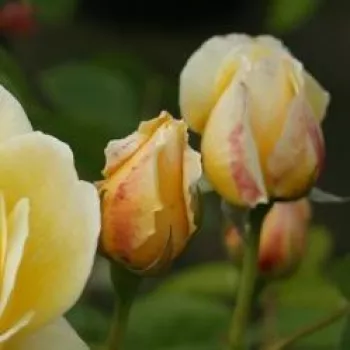
Soft creamy lemon-yellow with a deeper centre; colour lightens towards pale cream-yellow in strong sun, and appears richer in cool weather, giving a gentle, sunlit effect across repeat flushes. |
| Fragrance and aroma |
Medium-strength, clearly noticeable tea-scented fragrance, refined rather than overpowering, adding a classic English rose character around paths, seating areas and windows when in bloom. |
| Hip characteristics |
Because of the very double flowers, hip set is sparse; occasional small ellipsoidal orange-red hips, typically 7–12 mm in diameter, may develop late in the season on some sprays. |
| Resistance and winter hardiness |
Hardy to approximately –32 to –29 °C (RHS H7, USDA 4b, Swedish zone 5); needs regular protection against powdery mildew and monitoring for black spot and rust under humid conditions. |
| Horticultural recommendations |
Best in well-drained soil with consistent moisture; spacing 65 cm in beds, 55 cm in hedges, 100 cm as solitary shrubs; own-root plants respond well to periodic renewal pruning as they mature. |
Charlotte English Rose AUSpoly offers romantic yellow rosettes, a neat shrub form and durable own-root growth for long-term family gardens, making it a thoughtful choice if you seek dependable beauty with manageable care.