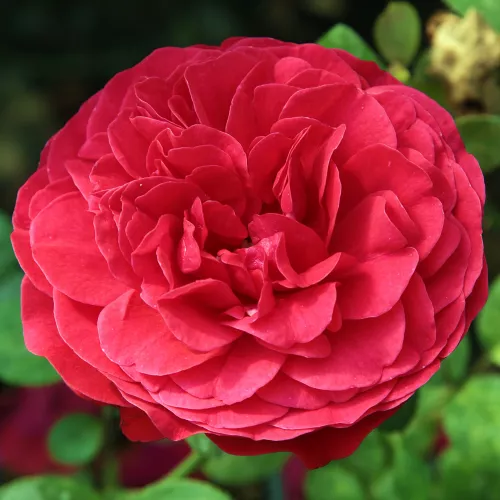
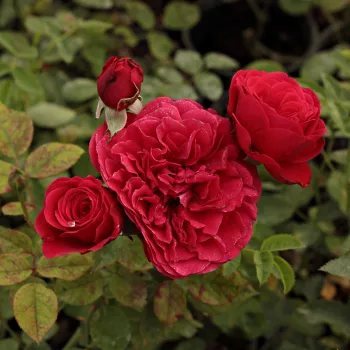
A uniform, intense scarlet-red shade that fully and evenly covers the petals. - floribunda bedding rose - mild, restrained-scented rose - scent description not available
– Uniform, intense scarlet-red cluster blooms.
– Reliable remontant habit, flowers repeatedly.
– Bushy, upright growth for beds and hedges.
– Glossy dark green foliage gives strong contrast.
– Excellent resistance to mildew, black spot, rust.
– Special feature: Awarded RNRS Trial Ground Certificate in 1951, a historic, time-tested floribunda.
Continuous availability – Variety guarantee
pharmaROSA® ORIGINAL 2-litre own-root potted rose
18,20 £
Unfortunately, we are currently unable to ship to the United Kingdom; we only deliver to countries within the European Union. For more information, please contact us!
4.5(6650)
POMPADOUR RED™ – red bedding floribunda rose – Ruiter
If You are looking for a classic floribunda that simply performs, POMPADOUR RED™ offers clusters of scarlet blooms on an upright, bushy plant that fits effortlessly into small UK front gardens and cottage-style beds, even where raised borders help manage heavier soils and winter weather. Its reliable, season-long flowering means beds and borders stay lively from early summer onwards, while the low maintenance needs and strong disease resistance keep routine care straightforward for busy or less experienced gardeners. As an own-root rose it establishes steadily, building a durable framework that regenerates well over time for a long garden lifespan. Use it in small groups or low hedging to give a structured, tidy look without fussy pruning; larger containers from 40–50 litres also suit its bushy habit on patios or by the front door. Over the first few years it moves from focusing on roots, then stronger shoots, to full ornamental value, creating a settled feature You can simply enjoy with everyday confidence.
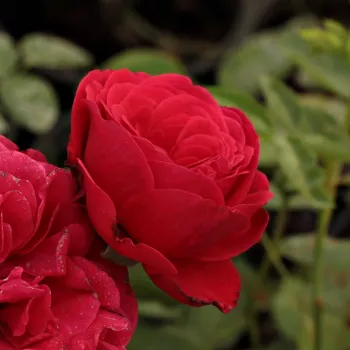
Pompadour Red™ shows colour states side by side as the blooms open.
Freshly opened scarlet-red bloom of Pompadour Red
Usage options
Target area
Reasoning
Front garden focal bush
The upright, bushy habit and moderately tall height give enough presence for a front garden focal point without overpowering a small plot. Use one or three plants near the entrance, where their dependable flowering and clean foliage create a welcoming, orderly impression for beginners.
Low flowering hedge along paths or drives
Planted at about 55 cm intervals, the even height and dense branching form a neat, low hedge that flowers repeatedly through the season. Good disease resistance reduces gaps and bare patches, so the hedge stays solid and colourful with only light annual trimming needed by homeowners.
Mass bedding in front gardens
For classic floribunda bedding, plant in groups at the recommended 65 cm spacing or 2–3 plants per square metre. The remontant, cluster-flowering character gives strong colour impact across the bed, with quick repeat flushes that keep the display going for urban-gardeners.
Mixed cottage-style border
The uniform scarlet-red clusters mix easily with perennials and shrubs, adding structure amongst looser cottage planting. Its glossy dark foliage provides contrast to lighter textures, while reliable repeat bloom supplies steady colour threads through the border that support aspiring stylists.
Large patio containers and doorstep planters
In 40–50 litre or larger pots, the compact spread and upright shape suit a single strong statement rose. Own-root growth adapts gradually to container conditions, building a stable framework with long-term resilience, so containers remain attractive over several seasons for busy town-dwellers.
Simple, low-effort rose feature for beginners
Low maintenance needs and robust resistance to common fungal diseases keep care tasks minimal: basic watering, feeding and a light prune are usually enough. This lets newcomers enjoy the look of a traditional scarlet floribunda without complicated techniques, building success for cautious starters.
Long-term structural planting in family gardens
As an own-root rose it forms its final bush shape in place, maturing into a stable, well-anchored shrub with good winter hardiness. Over the years it can be rejuvenated by harder pruning when needed, helping maintain form and flowering in evolving family gardens for experienced gardeners.
Beds in exposed or variable UK conditions
The balanced, upright framework and good disease resistance help it cope with typical British seasons, including wetter, windier spells where drainage or raised beds are helpful for root health. This structural reliability makes planting plans more predictable and less labour-intensive for time-pressed families.
Styling ideas
Classic-bedding – Arrange in formal blocks edged with low box or dwarf lavender for a traditional front garden carpet of scarlet – ideal for homeowners seeking a smart, orderly look with straightforward upkeep.
Cottage-border – Weave among airy perennials and old-fashioned favourites like foxgloves and hardy geraniums for relaxed charm – suited to cottage-garden enthusiasts wanting continuous colour anchors.
Pathway-hedge – Line both sides of a path at hedge spacing to create a gently enclosing corridor of red flowers – perfect for families wanting a simple feature that looks designed yet easy-care.
Patio-centrepiece – Plant one rose in a 50–60 litre clay or stone container with trailing thyme or lobelia at the base – for balcony or courtyard users who need colour and structure in compact space.
Seasonal-duo – Pair small groups with burgundy-foliage shrubs such as smoke bush to echo the red tones – a refined option for style-conscious gardeners planning long-lived compositions.
Technical cultivar profile
Parameter
Data
Name and registration
Floribunda bedding rose belonging to the bed rose group; registered cultivar name Pompadour Red, marketed as POMPADOUR RED™ for garden use and exhibition floribunda shows.
Origin and breeding
Bred by Gerrit de Ruiter in the Netherlands in 1951 from Orange Triumph × Anne Mette Poulsen; introduced by Jackson & Perkins Co., reflecting classic mid-century floribunda breeding aims.
Awards and recognition
RNRS Trial Ground Certificate (1951), indicating reliable garden performance and ornamental value under independent trial conditions in British-style climates and planting situations.
Growth and structural characteristics
Bushy, upright shrub reaching roughly 100–140 cm in height and 70–110 cm spread, with moderately dense, glossy dark green foliage and moderate prickliness suitable for structured bedding.
Flower morphology
Large, double, cupped blooms with about 26–39 petals borne in clusters; remontant with particularly abundant second flush, making it ideal for repeated seasonal bedding and cutting.
Colour data and phenology
Uniform intense scarlet-red flowers (RHS 46B outer, 53A inner); colour fades only slightly to a more matt tone, retaining even coverage from bud through full bloom until petal fall.
Fragrance and aroma
Mild, restrained fragrance, not primarily selected for scent; offers a light background perfume without dominating nearby seating or windows, suiting mixed borders and entrance plantings.
Hip characteristics
Hip set generally sparse due to very double flowers; occasional small globular hips 6–10 mm across, red and decorative at close range but not a major ornamental or wildlife feature.
Resistance and winter hardiness
Rated resistant to powdery mildew, black spot and rust; hardy to about –21 to –18 °C (RHS H7, Swedish zone 3, USDA 6b), giving dependable survival in most UK garden situations.
Horticultural recommendations
Low-maintenance floribunda for mass bedding, hedging or specimen use; plant 55–100 cm apart depending on effect, in well-drained soil with regular feeding to support repeat flowering.
POMPADOUR RED™ combines reliable scarlet flowering, strong disease resistance and a durable own-root structure that settles in for the long term, making it a thoughtful choice if You want dependable colour with modest effort.
Detailed product attributes
Product Identification Data
Product Name:
POMPADOUR RED™ – red bedding floribunda rose - Ruiter
Product Type:
pharmaROSA® ORIGINAL - 2-litre own-root potted rose
Meaning of Cultivar Name:
The name 'Pompadour' refers to Madame de Pompadour and the lavish hairstyle it evokes, while 'Red' denotes the colour of the flower.
Flower Colour Description:
A uniform, intense scarlet-red shade that fully and evenly covers the petals.
Closed Bud:
Deep scarlet red with a glossy surface and no variation in hue.
Newly Opened Flower:
Pure scarlet, with the petal edges a slightly darker tone.
Full Bloom:
Uniform scarlet red, the inner faces of the petals a shade deeper red.
Before Fading:
The scarlet red colour hardly fades and remains slightly matt.
Colour Fading Description:
The scarlet-red shade fades only slightly during opening and remains uniform until the end of flowering, at most becoming slightly matt.
Hip Comment:
Hip production is expected to be limited due to the double flowers; hips are occasionally produced, globular, 6–10 mm in diameter and red.
Our product is a rose grown with pharmaROSA®’s unique cultivation technology!
2-litre, own-root, potted rose.
With a shoot system appropriate to the season.
With a root system that thoroughly permeates the growing medium.
Quality compliant with the requirements of the E.N.A. (European Nurserystock Association).
Supplied in unique packaging that prevents damage.
Can be planted during frost-free periods.
True-to-variety rose bush with a unique identifier.
The pharmaROSA® own-root potted rose is a well-rooted plant that supports reliable establishment when planted and cared for properly, so it can be planted whenever the soil is not frozen.
Crop overview: several varieties and growth stages in a short crop section.Shoot system: intensive growth of fresh basal shoots on a young plant.Root system: demonstration of a vigorous root system permeating the growing medium, by removing the pot.Balance: mature plant with root system and shoots in harmony with each other.
Information about the videos
The video series is not a “seasonal showcase”; it illustrates the essence of pharmaROSA® own-root cultivation in a tangible way: how the plant is built up, what the root system is like and how the shoot system regenerates. The recordings were therefore made at different times and with plants at various stages of development, so mixed foliage levels and differing stages of growth may appear in the videos. They are not a ‘sample’ of the batch dispatched, but a visual explanation of how the technology works. The current condition of the rose available to order — typical for the given period and similar to what you can expect to receive in the parcel — is shown in the upper part of the product page.
Pages for private customers Garden roses for the family garden, with minimal care → ORIGINAL® Premium garden roses – instant impact, a truly showpiece garden → EXTRA® Pages for professionals and private customers Roses for public spaces – large areas, sustainable maintenance → NATURAL® Roses for projects – hedge and row planting, fast implementation → RAPID® For professional partners only Production – propagation material for garden roses, wholesale → NEONATAL®
Company details
PharmaRosa Ltd. Company registration number: 01-09-717479 VAT number: 13075314-2-43 Plant health registration no.: HU130721 Bank account (IBAN): HU85117631891388688400000000 BIC (SWIFT): OTPVHUHB Bank name: OTP Bank Nyrt.