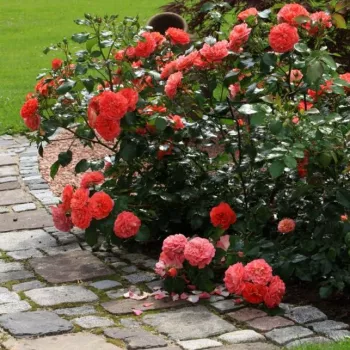
Vivid orange and golden‑yellow tones creating a warm colour effect. - bedding floribunda rose - mild, restrained-scented rose - slightly sweet, fruity character
– Vivid orange‑gold blooms with fairy‑tale charm.
– Reliable repeat flowering through the season.
– Compact, upright shrub for beds and hedges.
– Good heat and drought tolerance in summer.
– Award‑winning variety with ADR recognition.
– Special feature: Colour shifts from fiery orange‑red to soft pink, giving beds a constantly changing display.
Uniform growth – Biodiversity
pharmaROSA® ORIGINAL 2-litre own-root potted rose
19,70 £
Unfortunately, we are currently unable to ship to the United Kingdom; we only deliver to countries within the European Union. For more information, please contact us!
4(6311)
GEBRÜDER GRIMM® – orange bedding floribunda rose - Kordes
Colour-rich and fairy-tale blooms make Gebrüder Grimm® a cheerful choice for small British gardens, bringing warm orange and golden-yellow tones that soften to rosy pink in a long season of repeat flowering. Its upright, compact habit stays tidy in front gardens and narrow borders, while dense, glossy foliage supports a consistently neat structure. Bred by Kordes with ADR recognition and multiple show medals, it balances decorative impact with resilient performance, coping well even where strong winds and rain can batter more delicate roses. In a 2-litre own-root form it settles quickly, then over three seasons quietly builds from root establishment to steady shoot growth and finally full ornamental value, giving you a robust, long-lived feature that suits both beds and larger containers without demanding complicated gardening routines.
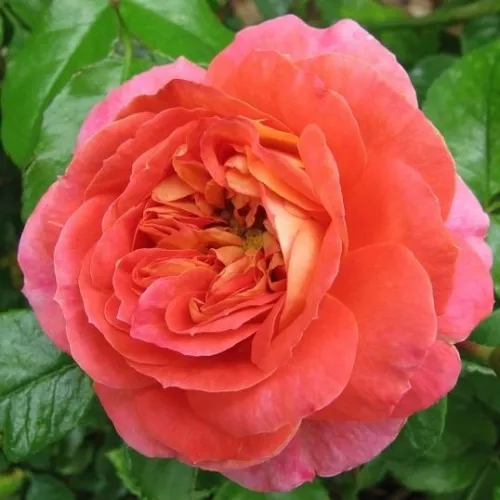
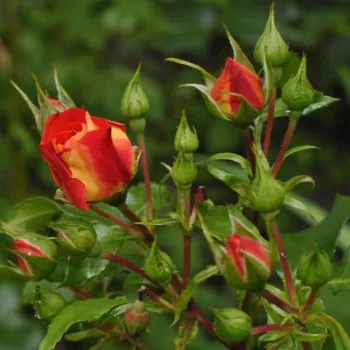
Freshly opened bloom of Gebrüder Grimm® with orange-red outer petals and golden-yellow tones inside.
A close-up of the mildly scented Gebrüder Grimm® rose in bloom.
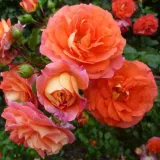
Gebrüder Grimm® in different opening phases, showing its shifting orange and golden-yellow tones.
Usage options
Target area
Reasoning
Front garden focal bed
The warm orange-to-pink colour shift creates a lively focal point from the pavement or driveway, while the compact, upright structure keeps the planting looking orderly rather than overgrown. Its consistent repeat flowering through the season means the bed does not look bare between flushes, ideal where you want an attractive view with limited upkeep for beginners.
Small mixed border near the house
The dense, glossy foliage and even growth habit help form a stable green backbone in short borders, with flower clusters held neatly above the leaves. Because the colour is strong without being harsh, it pairs well with perennials and grasses, giving a long-lasting framework that continues to perform year after year for homeowners.
Cottage-style planting with perennials
Frequent, well-formed clusters of rosette blooms combine attractively with catmint, blanket flower and other cottage perennials, giving a relaxed yet coherent look. The good heat tolerance and remontant flowering keep colour coming even in warmer spells, supporting a classic, loosely planted scheme that still feels reliable for cottage-garden lovers.
Low-maintenance family bed
Moderate self-cleaning means many spent blooms drop on their own, so the bed remains presentable even when deadheading is not done promptly. With medium maintenance needs and sound overall resilience, it suits busy households who can manage basic watering and an occasional tidy but prefer planting that largely “just works” for busy gardeners.
Decorative hedge or row along a path
Uniform, upright shrubs planted at hedge spacing create a colourful low border that reads as one continuous band of flowers. The consistent height and spread support a clear outline, while the shift from orange to soft pink adds gentle variation along the row, giving structured definition without the formality of clipped shrubs for style-conscious owners.
Feature shrub in large containers
In a pot of at least 40–50 litres, its compact stature and floribunda flowering give a generous display on patios or roof terraces. The own-root form knits into the compost and rebuilds well after pruning, allowing flexible shaping over the years while maintaining a stable, attractive outline for urban gardeners.
Weather-exposed urban or suburban sites
Bred for robustness, it tolerates heat and colder winters, with hardy wood and foliage that cope well with exposed positions and typical British swings in weather, even where frequent rain and wind would flatten looser shrubs. This makes it a dependable choice for front gardens facing the street for confidence-seeking planters.
Small group planting in beds and parks
Planted in groups of three to five, the even growth and rich clusters of flowers create a strong block of colour that reads well from a distance. Over time, the own-root bushes form a balanced stand with good regeneration, giving long-lived planting that ages gracefully without complex renewal work for long-term planners.
Styling ideas
Fairy-tale glow – Combine Gebrüder Grimm® with soft pink and apricot roses for a storybook entrance bed that echoes its namesake, ideal for homeowners wanting a welcoming, romantic front garden.
Sunset ribbon – Plant a low row along a path, edging with silver foliage plants to highlight the orange and golden tones, suiting those who like clean, structured lines with warm colour.
Cottage tapestry – Mix with Nepeta, Gaillardia and white obedient plant for a loose, pollinator-friendly look, perfect for cottage-garden enthusiasts who prefer relaxed, softly blended borders.
Patio accent – Grow one shrub in a 50-litre terracotta pot with trailing thyme at the base, a good option for balcony or courtyard gardeners seeking maximum effect from limited space.
Family-friendly bed – Group three plants in a small rectangle with easy-care perennials in between, designed for busy families who want reliable colour without intensive maintenance.
Technical cultivar profile
Parameter
Data
Name and registration
Gebrüder Grimm® MärchenRosen® (KORassenet), floribunda bedding rose, exhibition shrub rose; ARS name Gebrüder Grimm; own-root pharmaROSA® ORIGINAL 2-litre container-grown garden plant.
Origin and breeding
Bred by Wilhelm Kordes III, W. Kordes’ Söhne, Germany; parentage ‘Bernsteinrose’ × (unknown seedling × ‘Immensee’); introduced and registered in 2001 as a modern floribunda bed rose.
Awards and recognition
ADR award 2002; BUGA Potsdam gold 2001; Kortrijk silver 2001; Rome bronze 2002; RNRS Trial Ground Certificate UK 2000; TOPROOS award Netherlands 2006, confirming strong garden performance.
Growth and structural characteristics
Upright, compact shrub 85–115 cm high and 40–60 cm wide, with dense, glossy dark green foliage and moderate prickliness; forms uniform, bushy plants well suited to beds, borders and low hedging.
Flower morphology
Medium-sized, very double rosette blooms with 40+ petals, borne in clusters; repeat flowers generously through the season with a reliable second flush; moderate self-cleaning but benefits from occasional deadheading.
Colour data and phenology
Vivid orange and golden-yellow tones (RHS 33A outer, 14B inner) on opening, shifting to soft pink and peach as they age; colour lightens faster in strong sun but overall effect remains warm and cheerful in the border.
Fragrance and aroma
Mild, slightly sweet fruity scent, noticeable at close range without overwhelming nearby seating areas; chosen primarily for colour and flower form rather than perfume-centred plantings or cut-flower use.
Hip characteristics
Rose hip set is generally sparse because of the very double flowers; occasionally forms small, spherical orange-red hips around 6–10 mm in diameter, adding a light autumn accent where present.
Resistance and winter hardiness
Hardy to about −32 to −29 °C (USDA 4b, RHS H7, Swedish zone 5); moderate resistance to powdery mildew and black spot, resistant to rust; tolerates heat but appreciates regular watering in prolonged dry spells.
Horticultural recommendations
Suited to beds, low hedges, containers and specimen use; plant 45 cm apart in mass beds, 35 cm for hedging, 70 cm as specimens; thrives in well-drained soil with sun or light shade and routine feeding.
Gebrüder Grimm® offers vivid colour, compact form and dependable flowering on a long-lived own-root shrub that settles securely into family gardens, making it a thoughtful choice when planning your next planting.
Competition and Show Awards:
BUGA Potsdam gold medal (2001); Kortrijk silver medal (2001); RNRS Trial Ground Certificate, United Kingdom (2000); Rome bronze medal (2002); TOPROOS award, Netherlands (2006)
Pollinator Attraction:
Its semi‑double to fully double flower form and reduced accessibility of the stamens make it unattractive to pollinating insects.
Pollinator-Friendly Rating:
Its double flowers conceal the stamens, making it primarily an ornamental variety.
Hip Comment:
Rose hip formation is expected to be sparse due to the double flowers, occasionally producing spherical, orange-red hips 6–10 mm in diameter.
Our product is a rose grown with pharmaROSA®’s unique cultivation technology!
2-litre, own-root, potted rose.
With a shoot system appropriate to the season.
With a root system that thoroughly permeates the growing medium.
Quality compliant with the requirements of the E.N.A. (European Nurserystock Association).
Supplied in unique packaging that prevents damage.
Can be planted during frost-free periods.
True-to-variety rose bush with a unique identifier.
The pharmaROSA® own-root potted rose is a well-rooted plant that supports reliable establishment when planted and cared for properly, so it can be planted whenever the soil is not frozen.
Crop overview: several varieties and growth stages in a short crop section.Shoot system: intensive growth of fresh basal shoots on a young plant.Root system: demonstration of a vigorous root system permeating the growing medium, by removing the pot.Balance: mature plant with root system and shoots in harmony with each other.
Information about the videos
The video series is not a “seasonal showcase”; it illustrates the essence of pharmaROSA® own-root cultivation in a tangible way: how the plant is built up, what the root system is like and how the shoot system regenerates. The recordings were therefore made at different times and with plants at various stages of development, so mixed foliage levels and differing stages of growth may appear in the videos. They are not a ‘sample’ of the batch dispatched, but a visual explanation of how the technology works. The current condition of the rose available to order — typical for the given period and similar to what you can expect to receive in the parcel — is shown in the upper part of the product page.
Pages for private customers Garden roses for the family garden, with minimal care → ORIGINAL® Premium garden roses – instant impact, a truly showpiece garden → EXTRA® Pages for professionals and private customers Roses for public spaces – large areas, sustainable maintenance → NATURAL® Roses for projects – hedge and row planting, fast implementation → RAPID® For professional partners only Production – propagation material for garden roses, wholesale → NEONATAL®
Company details
PharmaRosa Ltd. Company registration number: 01-09-717479 VAT number: 13075314-2-43 Plant health registration no.: HU130721 Bank account (IBAN): HU85117631891388688400000000 BIC (SWIFT): OTPVHUHB Bank name: OTP Bank Nyrt.