Uniform, intense bright red shade. - polyantha bedding rose - very weak, barely noticeable scented rose - scent description not available
– Vivid, uniform bright red flower colour.
– Compact, densely foliated shrub habit.
– Remontant flowering with rich second flush.
– Good disease resistance, especially to mildew.
– Explicitly pollinator‑friendly single blooms.
– Special feature: Decorative red hips add autumn interest.
Sensitive landscaping – Built on experience
pharmaROSA® ORIGINAL 2-litre own-root potted rose
18,00 £
Unfortunately, we are currently unable to ship to the United Kingdom; we only deliver to countries within the European Union. For more information, please contact us!
3(4553)
AMULET™ – red bedding polyantha rose - Tanjga
This compact polyantha rose settles quickly into typical British front gardens, giving you a neat, low hedge or bedding edge of red flowers without complex care. Its small, flat blooms appear in generous clusters, repeating reliably so the bush stays lively and colourful across the season, while the open, single flower form is naturally pollinator friendly. Own‑root growth means the plant matures into a stable, balanced shrub with good long‑term lifespan and the ability to regenerate after harder pruning if required. In family gardens it copes well when given basic watering and feeding, and it rewards even modest attention with continuous flowering and tidy, rounded habit. Over time it forms a dense, glossy green backdrop that highlights its vivid blooms, working particularly well in small groups for a strong visual impact in beds or along paths, even in breezier sites where dependable anchoring and structure matter in everyday garden use.
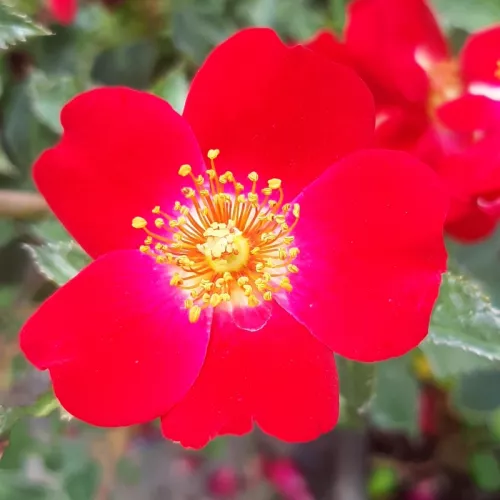
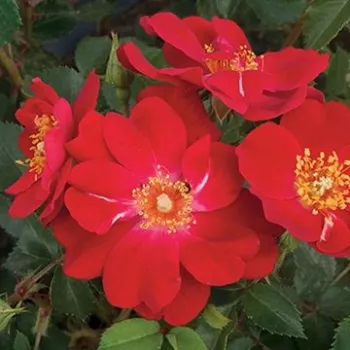
Freshly opened bright red flowers of Amulet™.
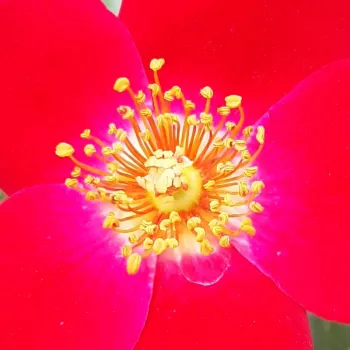
Close view of the open flower center of Amulet™.
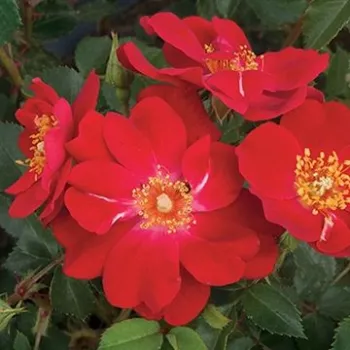
Amulet™ shows small, flat, single red flowers in clustered bloom.
Usage options
Target area
Reasoning
Front-garden low hedge along a path or drive
The compact, rounded growth habit keeps its shape with only light annual trimming, creating a low, tidy hedge that frames paths or drives without overgrowing them. Ideal where you want structure but minimal pruning knowledge, it offers a calm, reliable outline for beginners.
Small bedding groups in classic cottage-style borders
Planted in groups of three to five, the vivid repeat-flowering red clusters build a strong colour block that reads clearly from the street or house windows, even in modest beds. The consistent bloom size and form help the border look intentional and coordinated for style-conscious.
Mixed perennial border with emphasis on pollinators
The single, open blooms with exposed stamens are easy for bees and hoverflies to use, supporting wildlife-friendly planting schemes. Positioned among perennials like bee balm and campanulas, it adds season-long colour and nectar, reinforcing a softer, naturalistic look for wildlife-lovers.
Family play garden with clear, durable focal points
The dense foliage and moderate prickliness create a small, robust shrub that visually anchors beds without becoming too tall or imposing. This offers a clear planting “island” children can recognise, while still being manageable for adults to maintain for families.
Exposed or breezier suburban front plots
The low, compact build and well-branched framework help the plant stand firm in typical British wind and rain, avoiding the floppiness of taller roses. Once established, its structure copes well with unsettled weather, supporting dependable flowering for busy-owners.
Long-term, low-input rose bed for reliable colour
As an own-root shrub, the plant develops a stable framework and can regenerate from its base after pruning or winter damage, supporting a long lifespan with predictable performance. This underpins a rose bed that stays attractive for years with moderate input for planners.
Urban front garden planting with simple care routine
The combination of compact stature and disease-resistance profile suits small town plots where you want a smart look without intensive spraying. Given reasonable air movement and straightforward feeding, it maintains healthy foliage and flowers for time-poor.
Large containers on patios or by entrance steps
In a roomy pot of at least 40–50 litres with free-draining compost, the compact shrub form and repeat flowering provide months of colour close to the door. The sturdy framework anchors well and handles everyday weather around the house for homeowners.
Styling ideas
COTTAGE RIBBON – run a line of AMULET™ along a cottage-style front border, backing it with foxgloves and campanulas for vertical contrast – ideal for lovers of traditional village-garden charm.
SCARLET CARPET – plant a tight grid in a small bed to create a low red “carpet” of flowers, edging with lavender or thrift for a neat finish – suited to those seeking tidy, formal structure.
WILDLIFE STRIP – combine AMULET™ with bee balm and pincushion flowers in a sunny strip to draw in bees while keeping a clear, colourful edge – perfect for wildlife-focused but style-aware gardeners.
ENTRANCE POTS – place single plants in generous terracotta containers by the front door, underplanting with trailing thyme or ivy for softness – appealing to urban owners wanting quick kerb appeal.
FAMILY CORNER – group several shrubs near a seating or play area, mixing with hardy geraniums for a soft, low-maintenance surround – great for families after relaxed, robust planting.
Technical cultivar profile
Parameter
Data
Name and registration
Polyantha bedding rose from the Mella® collection; registered as BOZamulpap, marketed as Amulet™ Mella® BOZamulpap for garden and landscape use.
Origin and breeding
Bred by Biljana Božanić Tanjga, Pheno Geno Roses, Serbia, around 2018; introduced to the market in 2019 for use as a compact bedding and landscape shrub.
Growth and structural characteristics
Forms a compact, rounded shrub 35–55 cm high and wide with dense, glossy dark green foliage and moderate prickliness; suited to low hedges, edging and bedding schemes.
Flower morphology
Single, flat blooms 0.5–1.5 inches across with 5–12 petals, produced in clustered inflorescences; remontant with notably abundant second flush, ensuring repeated seasonal colour.
Colour data and phenology
Uniform bright fire-red petals, RHS 46B outer and 46A inner, holding vivid colour to full bloom before gently fading to pale raspberry-red near petal drop, offering stable ornamental effect.
Fragrance and aroma
Fragrance is very weak and barely noticeable, making it suitable where scent is unimportant or where you prefer visual impact without competing aromas near windows, seating or dining areas.
Hip characteristics
Produces moderate numbers of small, spherical red hips, around 5–8 mm in diameter, extending seasonal interest into autumn and enhancing wildlife value without overwhelming the plant.
Resistance and winter hardiness
Rated hardy to approximately −21 to −18 °C (RHS H7, USDA 6b, Swedish zone 3); disease profile indicates resistance to powdery mildew, medium black spot, and good rust resistance.
Horticultural recommendations
Prefers a sheltered, well-ventilated position; in very enclosed, humid urban courtyards may benefit from plant protection. Recommended spacing 35–70 cm depending on hedge, mass, or specimen use.
AMULET™ offers compact habit, vivid repeat-flowering red clusters and pollinator-friendly single blooms on a durable own-root framework, making it a thoughtful choice when planning an easy, long-lived rose feature.
Detailed product attributes
Product Identification Data
Product Name:
AMULET™ – red bedding polyantha rose - Tanjga
Product Type:
pharmaROSA® ORIGINAL - 2-litre own-root potted rose
Closed Bud:
Velvety, deep-red surface with a subtle sheen.
Newly Opened Flower:
Bright fire-red petals with a clear, uniform colouring.
Full Bloom:
The colour of the vivid red petals remains unchanged and saturated.
Before Fading:
The red tone slightly fades, taking on a pale raspberry‑red shade.
Colour Fading Description:
The bright red colour remains saturated until full bloom and, just before the end of flowering, fades slightly to a pale raspberry red.
Pollinator Attraction:
Its single flowers of 5–12 petals strongly attract pollinators because the simple flower form and exposed stamens provide easy access to nectar and pollen, increasing their attractiveness.
Pollinator-Friendly Rating:
Single-flowered variety with open blooms of 5–12 petals, explicitly pollinator-friendly and highly attractive to pollinators.
Maintenance Requirement:
Maintenance requirement moderate; performs well in a sheltered, well‑ventilated position, but in enclosed, humid urban courtyards may require plant protection.
Our product is a rose grown with pharmaROSA®’s unique cultivation technology!
2-litre, own-root, potted rose.
With a shoot system appropriate to the season.
With a root system that thoroughly permeates the growing medium.
Quality compliant with the requirements of the E.N.A. (European Nurserystock Association).
Supplied in unique packaging that prevents damage.
Can be planted during frost-free periods.
True-to-variety rose bush with a unique identifier.
The pharmaROSA® own-root potted rose is a well-rooted plant that supports reliable establishment when planted and cared for properly, so it can be planted whenever the soil is not frozen.
Crop overview: several varieties and growth stages in a short crop section.Shoot system: intensive growth of fresh basal shoots on a young plant.Root system: demonstration of a vigorous root system permeating the growing medium, by removing the pot.Balance: mature plant with root system and shoots in harmony with each other.
Information about the videos
The video series is not a “seasonal showcase”; it illustrates the essence of pharmaROSA® own-root cultivation in a tangible way: how the plant is built up, what the root system is like and how the shoot system regenerates. The recordings were therefore made at different times and with plants at various stages of development, so mixed foliage levels and differing stages of growth may appear in the videos. They are not a ‘sample’ of the batch dispatched, but a visual explanation of how the technology works. The current condition of the rose available to order — typical for the given period and similar to what you can expect to receive in the parcel — is shown in the upper part of the product page.
Pages for private customers Garden roses for the family garden, with minimal care → ORIGINAL® Premium garden roses – instant impact, a truly showpiece garden → EXTRA® Pages for professionals and private customers Roses for public spaces – large areas, sustainable maintenance → NATURAL® Roses for projects – hedge and row planting, fast implementation → RAPID® For professional partners only Production – propagation material for garden roses, wholesale → NEONATAL®
Company details
PharmaRosa Ltd. Company registration number: 01-09-717479 VAT number: 13075314-2-43 Plant health registration no.: HU130721 Bank account (IBAN): HU85117631891388688400000000 BIC (SWIFT): OTPVHUHB Bank name: OTP Bank Nyrt.